Thursday, 11 September 2014

The End of the Resting King

Having danced and laughed up the icy mountainside for many years, King Hyprius found himself at the tall and narrow peak of a slender mountain blanketed in snow. All about him the mountain sides fell away into the abyss below from out of which he did ascend and from which other bergs erupted, some taller and more magnificent, casting faint shadows about him.


Balancing on the summit in the heavens, the king looked down onto the great city of Zoë below; she rested, bathed in light and nestled in the bosom of her green fields. Yet the king looked on not in pride nor even in peace, but rather in terror and dismay.

Whilst he had enjoyed his lengthy solitude and respite during his ascension, a hideous fiend,  led on a rattling chain by its master, Argo, had crept silently into the king's courts and castles and had begun to raze the great city down to the clay from which it was moulded. Towers that had pierced the sky were being torn down, crashing into the houses of the confused peoples of the once solemn city, scattering them in every direction. Temples of fine marble were ripped, brick by brick, from their foundations, and their priests slaughtered in the streets, their sacramental goblets and altars dripping with their sanguine sacrifice in defense of their gods - rivers of life poured into the clear fountains painting red clouds of death in the water's play.


Not unlike an infernal whirlwind of pain, the groans of the people of Zoë were carried across the valleys to the ears of their king and he remembered the promise he had made with them before he abandoned them, and he mourned the loss of their fragile lives. A hurricane of torment swirled about the helpless and broken king, his anguish bringing him to his knees and bowing his once joyful head.

The beast, now grown and swollen with the pleasure and gluttony of its relentless scourge, plucked the innocent, fleeing men and women from their homes with twisted, clawed hands. Bathed in the euphoria of their suffering, the beast devoured them, tossing them into its colossal maw - a foul chasm which dripped with gore. Crooked shards lined that great hole; slick with warm ichor. Argo, resting sleepily in the throne of the king, watched, grinning with glee, as the city was brought down, torn asunder on his behalf by the vile creature that he had borne to yet another fertile and unattended land.

Furious at his drowsy complacency and the crude, terrifying titan he had allowed into his midst and permitted to demolishes his creation, the King Hyprius drew his sword - Epitychia, and held an ornate ivory aegis to his breast. Hammering against his shield the king lets out a great cry, a call so magnificent that the beast stopped in the midst of its cruel works and turned to face its challenger, staring up with a single eye, which swivelled and leered out from between two empty sockets.

Argo, glaring at the king from the throne, grimaced and unleashed his brutish pet toward its defiant prey atop the mountain. The fiend bounded, jaws agape, toward the king. Leaping from the mountain top, the king hurtled downwards, back toward the deep abyss, falling to meet and slay the beast. Into the abyss, where the titan raced up to meet him, the king, armed with sword and shield, called the monster's name - Mediocritus!

Thursday, 2 January 2014

Life's Arrow Soars into the Styx

The horde formed an all consuming din, the noise rising and soaring like a great vulture, its wings enveloping the mass of bodies in the hum. Mouths flapping and eyes darting, their minds converging and overlapping. A cacophony. A travesty.
     The wisest men abandoned their cries to one another and threw their arms up to the sky, calling out to the winds for a gale to silence and still the many tongues.
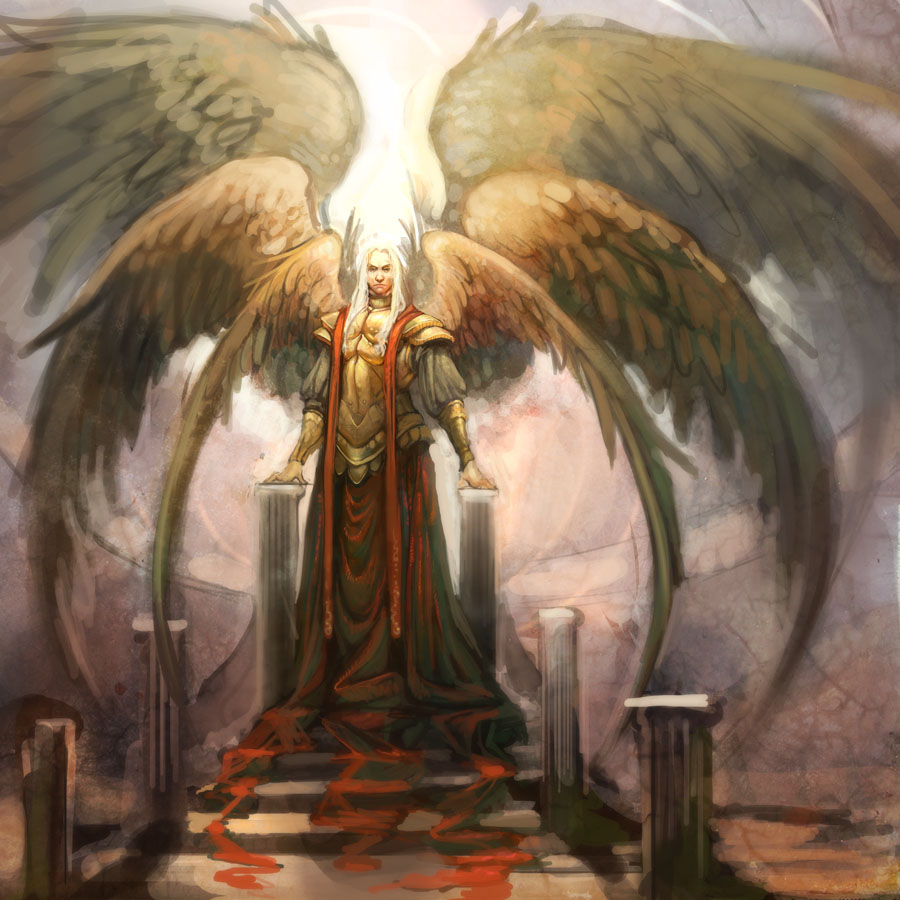
     Light shone out from among them, and in their midst there stood an angel of terrifying beauty. Wings about him, he began to speak unto the chattering crowd.
  
     "No longer will there be gods and goddesses whose wisdom falls down to you as rain to the parched earth. Your clay is dry, your soil caked and cracked, powdered, red as blood.
    "They have not abandoned you. No, for you yourselves are they. Your saddest moment was when you turned, submissive, to the waters above for your aid - when your spring was your life, you begged for rain, ignoring the deluge within, remaining trapped in the clouds of your minds, prowling the surface for opportunities to unleash their divine shower.
     "Such grand repose, such great serenity which befalls you in the dark shadows cast by those passing clouds - like gruesome slugs in the midday sun you creep, slowly toward the shade, lest you curl up under that magnificent luminous star.
     "What you flee from is manifest by and from you, drawn out from you and laid before you, even as the sea herself is laid as a blanket before the mountain, in placid pools and torrents - the absurdity!
     "Olympus has thundered and cracked its last bolt of lightning. As a weed-ridden corpse it now stands - a temple made of bones, destined only for dust and ash. You have claimed it as your own. The gods and goddesses left that tomb and now they reside in each of you - yet this great exodus has a beautiful mask which hides the true image beneath, a mask I shall flay from the betraying face.
    "You, children, are doomed - as that shadow cast by the inevitability of your charge begins to tower over you. Thick tendrils of darkness are upon you, wrapping your throat and climbing within you, so that that blackness may rise up from inside the new temple . The world is yours to paint from out of this blackness, and upon you shall the world reflect - you are the painter and the canvas!
     "To you I pour forth my sympathy and congratulations, for I see before you a great freedom to choose which chains you would have bind you - ha! Your creation is your prison. Could you not see it? Your great art is your window pane through which you can see your work, your divinity, enacted but always beyond your reach - never touched. To make the fruit and find it forbidden - what freedom! The strokes of your eye's brush, that is your knowledge, that is your victory.
     "Verily I say unto you, Olympus' end has been, yet Hades lies in wait, bedecked in expectancy, bathed in the mists of the river Styx whose currents slide through you.
     "Warrior! - fire your arrow into that putrescent sea and watch it pierce the lonely cloud, only to fly deep within that ghoulish maelstrom. The waters, thick with the lost anon, pour out from you, from the abyssal well within you. Cavernous it is, yet in you it dwells, around, not beneath, it is always before you.
     "So cower in the clouds if you must, yet know that they are a deception, ascending from those abysmal waters, floating through fear and terror - thus they inherit their black colour, for only in that blackness is light absorbed, consign yourself to the dark, coward!
     "Do you not remember that glow and glory? Run to it and embrace its warmth, as Icarus took to the sky in foolishness and courage so too you must chase that light. Yet do not fly too close, for your wings too may fail, and flames can give unto the air the blackest smoke.
     "Curse the clouds! Drive them out! But keep that ferryman in view. Fear him. Love and create light, but do not let its warmth make you drowsy - even the Fates leave one eye open! I have revealed these things to you so you may know that you are the gods and goddesses imprisoned within your own temples. Statues for whom there are no worshippers. Your houses are fettered with chains and curses, and whose destiny is to be ablaze with fancy until those waters, whose debris are the souls and dreams of fallen heroes and heroes never risen, douse and blot out that glimmering candlelight.
     "You may light your match, I grant you this privilege, but do not forget that it burns bright only shortly, and with its very last light it shall scold your fingers as you clutch it, ceasing to drive back that surrounding blackness which is ever waiting, poised."
     Having said these things, the angel disappeared, the crowd still talking amongst themselves and crying out for a message or sign to guide them and show them the way to silence, not knowing that what lay within them was silence eternal, a destitution slumbering in their midst. The wind would not blow amongst them again.
 

Wednesday, 18 December 2013

The Fears and Hopes of the Deluvians

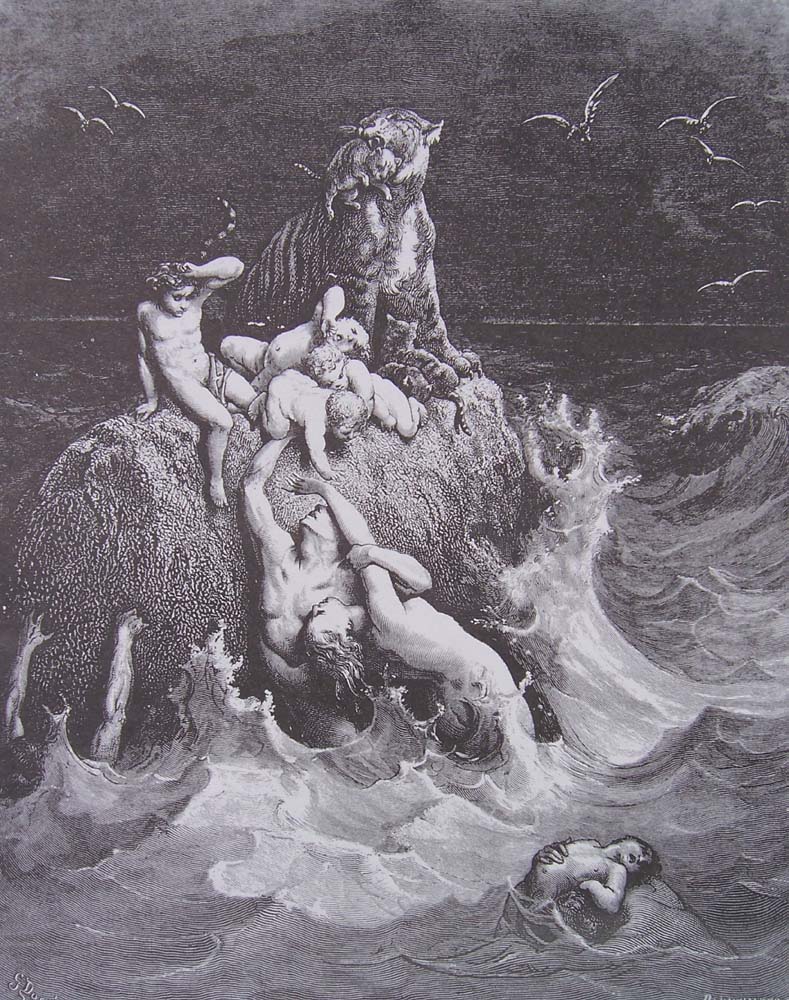
When the deluge came and the waters rose, many men and women in terror did flee to high ground. There, still, the waters would chase them, that churning sea, whose maw was black and teeth foaming white, would pursue them. Having reached the mountain's peak, they clung desperately to the rocks. However rough or deep they cut, the people would not release their trembling hands from those jagged rocks, as the cold and fierce maelstrom tore at their flesh.


They held on in fear. Fear of the death that rose all about them, a death that relentlessly threatened to engulf and consume them. Their holding on was futile, as that inevitability washed over their eyes and ears, and only in death, accepting their fate, their defeat, did they come to rest, to sink, to be at peace.

They held on in hope. Hope that the fate thundering toward them may relax its pursuit, that they might see destiny recede its advance. The rock might be an anchor to them, a saviour, or a redeemer. To them the rock was a god - it was life. That hope blinded them from the truth of their damnation. Oh! The horror they might have been spared had they come away from that rugged stone and embraced the churning water. What peace they might have had - what calm.

Tuesday, 25 September 2012

Milton's Satan: Understanding Satan

Recently I read Milton's Paradise Lost and had some thoughts on his literary illustration of  Satan, namely my admiration for the character's ceaseless ambition in the face of endless defeat. The fallen angel, despite being pitted against incalculable odds, remains defiant and determined after his original demise, judging proper the ways in which he must act against the one who has set himself above all others and submitted Satan's rebellion to cruel punishment for their disdain at his tyrannical reign.
http://fc00.deviantart.net/fs30/f/2008/162/b/a/unfinished_Lucifer_design_by_jdillon82.jpg
        The first thing I want to make clear is that, to appreciate this post, you must do away with preconceived notions of Satan and accept that this is using my interpretation John Milton's Satan only. This post utilises the aspect of this character which are most apt for the discussion. What it does not do is glorify the Christian notion of Satan or Satanic worship. I do not wish for everyone to appreciate Satan, just Milton's Satan.
        
        The scene is as thus: Satan and his army have been cast down from heaven into the barren, burning wastes of Hell. Pits of fiery sulphur and red hot boulders light Satan's men with fiery punishment. Chained to the stones which scorch them they lie defeated and sickened with despair. The first of them to rouse is Satan himself. Followed by his friend Beelzebub, he gives a moving and motivating speech to his fellow fallen comrades, calling for them to rise with him in defiance of this outrageous defeat. Here is an excerpt from Milton's Paradise Lost of that very speech:
What though the field be lost?
All is not lost: the unconquerable will,
And study of revenge, immortal hate,
And courage never to submit or yield,
And what is else not to be overcome;
That glory never shall his wrath or might
Extort from me.  
https://blogger.googleusercontent.com/img/b/R29vZ2xl/AVvXsEjkHbjzOK5bu8itxk425jv-Bx88KVCskdI9qK2MEs41srQFhfp4Wtj1BcPpaBbBsTlJlsg7UydgAJNNgoc0nRw6Uh5_4KGfmU5ElXbjNldC5kkMDrZFRitqS3SiroNQPTJoQXR6wN3OFsZh/s1600/Paul+Gustave+Dore+Paradise+Lost+Satan+talks+to+the+council+of+Hell.jpg The raw defiance wrought into every word and spoken on tortured tongue fuels a passion drunk on purest emotion both vengeful and undeterred. It is as though he were gripping my wrist and lifting me from the ground himself. Seeking only to end the tyrannical reign of heaven which torments him and his devoted companions eternally, he is ever the humble and sacrificing warrior for a cause doomed to fail yet which he presses to see raised to great acclaim and accomplishment, not for his sole benefit but for that of those who depend upon its success also, his 'co-partners', 'princes',' potentates' and 'warriors'.

 Satan desires only to rouse his men and stir them back into action even whilst they yet sting from the confusion and anger at their peril at the hands of the Conqueror. They have suffered defeat yet he wishes them to see the opportunity which has arisen from their loss, to see the good even in hell itself. He raises them up to continue their resistance and ensure their efforts do not become vain but are maintained through the fixed intent for success through defiance and deviation.

Fallen cherub! To be weak is miserable,
Doing or suffering. But of this be sure:
To do aught good never will be our task,
But ever to do ill our sole delight,
As being the contrary to His high will
Whom we resist.

Satan wished for freedom for all those bound to serve, a cause which is surely not unjust or unacceptable. Equality and mutual respect is his desire and these are not to approach with scorn when the only choice which stands is bondage in heaven or freedom in hell. He could not continue in eternity imprisoned by the one he was forced to admire, and neither could many others who joined his outrageous rebellion. Yet as Satan says to his fallen angels as they are free to recover from battle and not under the gaze of Him they fought:

Better to reign in hell than serve in heaven.
The conquering of Heaven was and continued to be an impossible task. The King of Heaven had omnipotence to contest reprisal and had proved his capacity for quelling even the fiercest of rebellions.  Satan is no fool and undoubtedly knew the danger when launching his reckless campaign, yet that did not stop him for though both him and his warriors could not achieve their aim they at the very least fought for it and that is far more admirable than any submissive tolerance under oppression.

Peace is despaired. 
For who can think submission? War then, war
Open or understood, must be resolved.

In the next part I will discuss how Satan's attitude toward an impossible yet vital cause and his reaction to defeat in pursuit of its fulfilment resounds in and encapsulates the very nature of  the rebel and how we all must aim to apply this same level of persistence and commitment when we hold our own cause in the face of impossible odds.

Nihil Creatum Nihil

‘Existence precedes essence’- so said Sartre in Being and Nothingness. Loathe as I am to quote him I feel he may have a point, to tell the truth I believe that, though his statement suggests that essence is qualified by the undeniable existence from which it originates and the statement itself originates from no sensible or reducible existing thing to begin with, Sartre was right to suggest that there must be the existence of a thing in order for the title of ‘thing’ and the ‘thing’s’ attributes to be applied to the thing-in-itself. Anyway, I digress, my point is simply this, whilst Sartre had something going I believe he wasn’t hitting the proverbial nail on the head. Let me explain.
                The concept of all our essential essences or attributes being derived from the existence of that to which we apply them, not that which exists being derived from its essential essence is, for want of a better phrase, bang tidy. Though I believe the appreciation for the existence of that from which essences are derived is itself an essence of what is effectively nothing, that is, nothing until we apply existence and begin to gift it the opportunity of being understood as something, as in something which exists rather than a nothing which is yet to be made some existing thing.
                Essentially everything begins as nothing. There is only nothingness to work with and out of that we create something. I know what you’re thinking, creatio ex nihilo is absurd and instantly I demonstrate to you that the phrase which is used too often to combat the biblical term, ‘nothing can be created from nothing’, attributes nothing as being something which we can discuss and as such grants nothingness the existence it requires to become a topic to be spoken of and thus it is indeed ‘nothing’ which is created from nothing. The phrase and appreciation of that which it addresses creates both the addressee and the attributes which allow for it to be spoken of. Now I’ll return to what I was saying. We effectively create the entire world in which we exist at every moment (that is one continual moment as opposed to several individual perceptions) through means which I’ll not begin to discuss here.
                We begin our phenomenological careers with absolute nothingness to work with. There is no appreciation for the differentiation and categorisation of those components of our existence which we allow to influence us. It is not until we step into nothingness, move forward into the void to see what we can decide she possesses that we begin to build, brick by brick, the scene of our existence and our entire universe. We become the architects, taught by the patriarchs who found our lives and governed by the biological powers which boil within us and steer us this way and that. We become so masterful at this basic yet all too complex art that we fool ourselves into believing that we are in fact living a life which is created outside of ourselves. The truth of the matter is we have been shown how to build the dome in which we live and have the grazes to prove it, we just don’t want to accept we have done the legwork lest we realise that our efforts are in fact potentially poor and presumably pointless as, with death, our works will end and the dome will crumble with our bones. We try to step outside the dome, marvel at its craft and shout at praise at the one that created it, whether that be science, society, nature or the divine or some other toy which sits inside the dome with us.
                I have glimpsed the edge of the dome and felt its rough and shoddy edges. I have held the toys of abstraction and seen them torn and misshapen. I have opened my eyes to my prison of my own making. I have founded my freedom and my cage at once and both have originated from nothingness. I am the creator of my own demise and it is that much crueller for it. So are you also the formula which amazes you. Depressing? No. Pointless? Maybe. The effect of the torture is not unlike the cause, the only thing you need do is become a positive cause and not negate your influence on the effect. Stop relying on the creation to advise the creator but stroll around the dome and create more, just do it with some finesse this time because, to tell the truth, right now I think all our prisons could do with a lick of paint. Which colour will you create?

Thursday, 21 June 2012

The Meaninglessness of Mathematics and Money

http://www.falkirklocalhistorysociety.co.uk/images/Coins.jpgThis is not a tirade against maths and money. This is an attempt to acknowledge the acceptance of these abstractions as being inappropriately attributed as absolutes. Abolishing the angst around these abstracts will allow the able to access their abreaction through the abjuration of these abominable assumptions. In short both mathematics and money are two of many abstract concepts given meaning and importance which is then taken as being inheritable in the things themselves. A realisation made when the statement 'Mathematics means nothing.' was met with startled, perhaps even offended, faces.
Math board
        What, then, do I mean when I say abstract? These abstracts are ideas which have no physical representaion and are, as such, non-physical entities which exist only as ideas. These ideas may assigned to physical things but they are not the physical things themselves. Money is not the little metal pieces which rattle in the pocket, nor is maths the ink or chalk squiggle which rests on the white/black board. They are ideas. They are abstracts. These abstracts can therefore acheive no meaning which originates from themselves. Money is not worth anything because it has inherent worth, nor does mathemetics work because the numbers and equations involved are essentially arranged to equate. The metal and markings are attached to meanings which originate not from themselves but from an individual. That is they are ideas and remain ideas even when applied to things which exist physically because they are not themselves pysical entities.
      
        The world is an entity which pre-exists any applicable essence. Thus it is naturally chaotic, unpredictable and irrational. It is also meaningless. Humanity requires a world which is controllable and subduable. Thought is used to supress this chaos by applying abstractions which form structures of control. Therefore these abstractions are  illusory concepts which create an ordered world in which humanity can live in absence of the fear which once consumed it.
      
        It is clear that the utility of the abstract is not in question here. Money is still useful, as is mathematics, yet only in societies where they are depended upon for maintainance of the established structures. Utility, however, is not commensurate with meaning. Abstractions  are therefore gifted a purpose but do not have innate meaning. This is because the abstract-in-itself is utterly meaningless whilst the intention attributed to it is an empowering phenomenon which leads those who accept the intention as appropriate to gain an appreciation for the usefullness of the abstract. This cannot be allowed to mask the meaninglessness of the abstract-in-itself. Unfortunately it appears that the utilisation of the abstract causes many to understand it as a necessity and not an optional form of order. Abstracts which are successful are not, nor will they ever be, necessary.
       
        We reach the conclusion of this breif investigation into the meaning (or lack thereof) of abstracts. As they have been established as external, influential ideas which attempt to impose order on the chaos of the world they are at once both meaningless and unnecessary. Though they cannot be avoided, for, if we were to decide not to use money or mathematics for example, the systems we have now become dependant upon would collapse and we would need to reform our understanding of a countless range of disciplines and ideas we take for granted. Again, dependency does not equate to necessity, many civilisations past and present have existed successfully in the absence of mathematics, money and countless other abstracts, yet they have developed their own abstracts with which to understand the cosmos in a structured way. Abstracts are authoritative only as far as we allow them to become an authority over us. As such they also have meaning only as far as we attribute meaning to them. Abstracts necessitate human meaning, human's cannot draw meaning from necessity to abstracts.

Sunday, 17 June 2012

Zombie Nation Part 3: The Cure


The living dead are innumerable and their fate seems sealed as they are determined to maul and murder the last vestiges of their humanity and devour their brains into stupidity. The only hope left is that they allow a few daring soldiers of truth and life to deliver the drug which will cure them of their disease of benightedness. The cure is revolution and its side-effect is freedom. This revolution will not overthrow kings or governments, that freedom lasts but a short while for it is not a revolution realised within ourselves. Where the fear strikes in our hearts and minds is where it will be overturned and, with the power over us overthrown, the controlling forces that be begin to become powerless. This cure is the most difficult to accept and the most arduous to administer but it is the most effective and powerful.
     
        Internal revolution requires the person to entirely reorientate themselves so that they may become the source of their own empowerment and they are their own means to contentedness. Abadonment of reliance on any form of external authority is to be exacted immediately. For too long those who have broken backs with their burdens have scoffed at the impoverishment of the horde's member's identity. Those barbaric, bulbous behemoths must be left to rot in their conspiring cowardice and will have to watch as our eyes clear, our thoughts return and we become human once more. Do not let them control you with fear. Become your own control and you will learn to abolish fear and acheive the ambition you once knew you had within you. We can and must do what we dream or else our lives will have culminated in nothing of any worth either to us or anybody else.
 
        To begin the revolt and embrace the cure we must realise our condition. We must be encouraged to question our existence, our being and what we believe we know. Without a mind experienced in thought this can sometimes be near impossible, revolution is new and confusing. Nonetheless, the horde must stop being a mass of rotted nothings and become individuals with worth, value and, above all, freedom. The choices will still exist, as will the pressures, for the baleful wails of the monstrous rulers will continue to echo long after we have left them to die and their shadow will continue to darken our lives forever. Yet we will not be bullied or coerced underneath their crushing weight but will throw them aside and decide the right for ourselves. Zombies, fulfil your dreams, live the lives you ought to have done from them start. Cast aside your chains and be free to rule yourselves for it is what you are owed after a lifetime of dissatisfaction and hunger for truth and happiness. We who are the fomenters of revolution will distribute knowledge and wisdom to enlighten and develop individuality so that we may live lives of effective contemplation and not pure, blind, fatalistic pragmatism.
     
        As for now we can only keep trying to permeate that hard shell of ignorance which has formed around the minds of the living dead. The virus is out, the infection has taken hold and zombified the nation, but revolution is here to cure it. The pariahs will gain power. The volitional revolution has begun. 
Think and be free.