Tuesday, 25 September 2012

Milton's Satan: Understanding Satan

Recently I read Milton's Paradise Lost and had some thoughts on his literary illustration of  Satan, namely my admiration for the character's ceaseless ambition in the face of endless defeat. The fallen angel, despite being pitted against incalculable odds, remains defiant and determined after his original demise, judging proper the ways in which he must act against the one who has set himself above all others and submitted Satan's rebellion to cruel punishment for their disdain at his tyrannical reign.
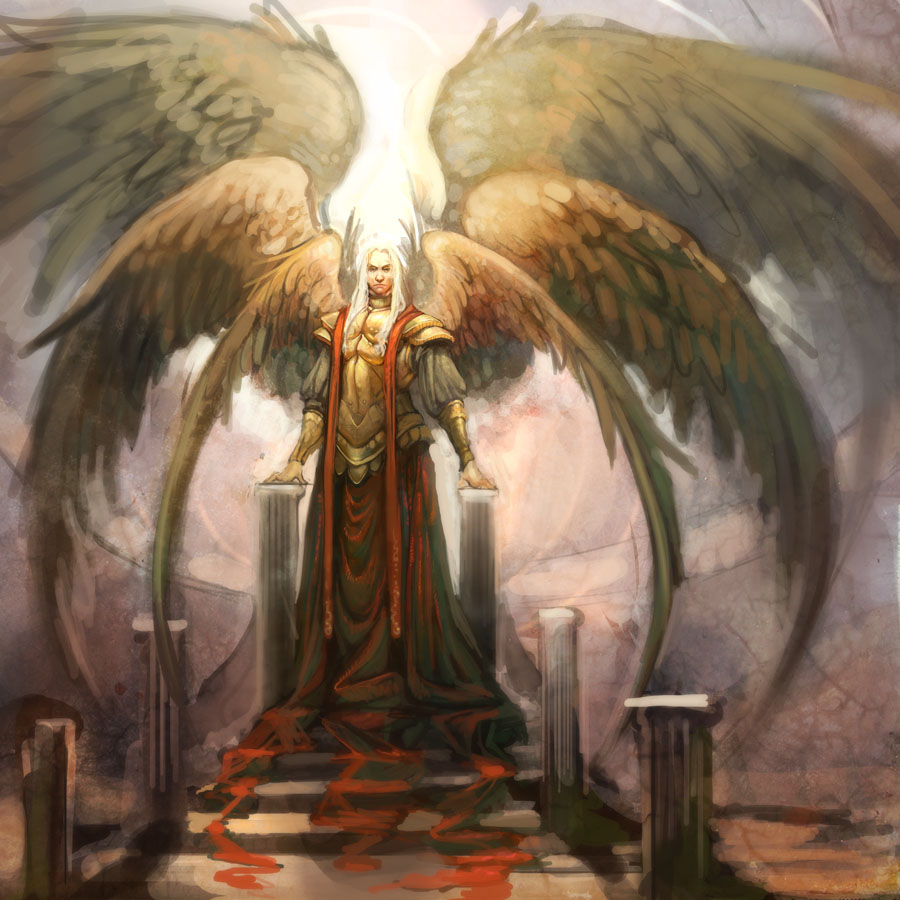
http://fc00.deviantart.net/fs30/f/2008/162/b/a/unfinished_Lucifer_design_by_jdillon82.jpg
        The first thing I want to make clear is that, to appreciate this post, you must do away with preconceived notions of Satan and accept that this is using my interpretation John Milton's Satan only. This post utilises the aspect of this character which are most apt for the discussion. What it does not do is glorify the Christian notion of Satan or Satanic worship. I do not wish for everyone to appreciate Satan, just Milton's Satan.
        
        The scene is as thus: Satan and his army have been cast down from heaven into the barren, burning wastes of Hell. Pits of fiery sulphur and red hot boulders light Satan's men with fiery punishment. Chained to the stones which scorch them they lie defeated and sickened with despair. The first of them to rouse is Satan himself. Followed by his friend Beelzebub, he gives a moving and motivating speech to his fellow fallen comrades, calling for them to rise with him in defiance of this outrageous defeat. Here is an excerpt from Milton's Paradise Lost of that very speech:
What though the field be lost?
All is not lost: the unconquerable will,
And study of revenge, immortal hate,
And courage never to submit or yield,
And what is else not to be overcome;
That glory never shall his wrath or might
Extort from me.  
https://blogger.googleusercontent.com/img/b/R29vZ2xl/AVvXsEjkHbjzOK5bu8itxk425jv-Bx88KVCskdI9qK2MEs41srQFhfp4Wtj1BcPpaBbBsTlJlsg7UydgAJNNgoc0nRw6Uh5_4KGfmU5ElXbjNldC5kkMDrZFRitqS3SiroNQPTJoQXR6wN3OFsZh/s1600/Paul+Gustave+Dore+Paradise+Lost+Satan+talks+to+the+council+of+Hell.jpg The raw defiance wrought into every word and spoken on tortured tongue fuels a passion drunk on purest emotion both vengeful and undeterred. It is as though he were gripping my wrist and lifting me from the ground himself. Seeking only to end the tyrannical reign of heaven which torments him and his devoted companions eternally, he is ever the humble and sacrificing warrior for a cause doomed to fail yet which he presses to see raised to great acclaim and accomplishment, not for his sole benefit but for that of those who depend upon its success also, his 'co-partners', 'princes',' potentates' and 'warriors'.

 Satan desires only to rouse his men and stir them back into action even whilst they yet sting from the confusion and anger at their peril at the hands of the Conqueror. They have suffered defeat yet he wishes them to see the opportunity which has arisen from their loss, to see the good even in hell itself. He raises them up to continue their resistance and ensure their efforts do not become vain but are maintained through the fixed intent for success through defiance and deviation.

Fallen cherub! To be weak is miserable,
Doing or suffering. But of this be sure:
To do aught good never will be our task,
But ever to do ill our sole delight,
As being the contrary to His high will
Whom we resist.

Satan wished for freedom for all those bound to serve, a cause which is surely not unjust or unacceptable. Equality and mutual respect is his desire and these are not to approach with scorn when the only choice which stands is bondage in heaven or freedom in hell. He could not continue in eternity imprisoned by the one he was forced to admire, and neither could many others who joined his outrageous rebellion. Yet as Satan says to his fallen angels as they are free to recover from battle and not under the gaze of Him they fought:

Better to reign in hell than serve in heaven.
The conquering of Heaven was and continued to be an impossible task. The King of Heaven had omnipotence to contest reprisal and had proved his capacity for quelling even the fiercest of rebellions.  Satan is no fool and undoubtedly knew the danger when launching his reckless campaign, yet that did not stop him for though both him and his warriors could not achieve their aim they at the very least fought for it and that is far more admirable than any submissive tolerance under oppression.

Peace is despaired. 
For who can think submission? War then, war
Open or understood, must be resolved.

In the next part I will discuss how Satan's attitude toward an impossible yet vital cause and his reaction to defeat in pursuit of its fulfilment resounds in and encapsulates the very nature of  the rebel and how we all must aim to apply this same level of persistence and commitment when we hold our own cause in the face of impossible odds.

Nihil Creatum Nihil

‘Existence precedes essence’- so said Sartre in Being and Nothingness. Loathe as I am to quote him I feel he may have a point, to tell the truth I believe that, though his statement suggests that essence is qualified by the undeniable existence from which it originates and the statement itself originates from no sensible or reducible existing thing to begin with, Sartre was right to suggest that there must be the existence of a thing in order for the title of ‘thing’ and the ‘thing’s’ attributes to be applied to the thing-in-itself. Anyway, I digress, my point is simply this, whilst Sartre had something going I believe he wasn’t hitting the proverbial nail on the head. Let me explain.
                The concept of all our essential essences or attributes being derived from the existence of that to which we apply them, not that which exists being derived from its essential essence is, for want of a better phrase, bang tidy. Though I believe the appreciation for the existence of that from which essences are derived is itself an essence of what is effectively nothing, that is, nothing until we apply existence and begin to gift it the opportunity of being understood as something, as in something which exists rather than a nothing which is yet to be made some existing thing.
                Essentially everything begins as nothing. There is only nothingness to work with and out of that we create something. I know what you’re thinking, creatio ex nihilo is absurd and instantly I demonstrate to you that the phrase which is used too often to combat the biblical term, ‘nothing can be created from nothing’, attributes nothing as being something which we can discuss and as such grants nothingness the existence it requires to become a topic to be spoken of and thus it is indeed ‘nothing’ which is created from nothing. The phrase and appreciation of that which it addresses creates both the addressee and the attributes which allow for it to be spoken of. Now I’ll return to what I was saying. We effectively create the entire world in which we exist at every moment (that is one continual moment as opposed to several individual perceptions) through means which I’ll not begin to discuss here.
                We begin our phenomenological careers with absolute nothingness to work with. There is no appreciation for the differentiation and categorisation of those components of our existence which we allow to influence us. It is not until we step into nothingness, move forward into the void to see what we can decide she possesses that we begin to build, brick by brick, the scene of our existence and our entire universe. We become the architects, taught by the patriarchs who found our lives and governed by the biological powers which boil within us and steer us this way and that. We become so masterful at this basic yet all too complex art that we fool ourselves into believing that we are in fact living a life which is created outside of ourselves. The truth of the matter is we have been shown how to build the dome in which we live and have the grazes to prove it, we just don’t want to accept we have done the legwork lest we realise that our efforts are in fact potentially poor and presumably pointless as, with death, our works will end and the dome will crumble with our bones. We try to step outside the dome, marvel at its craft and shout at praise at the one that created it, whether that be science, society, nature or the divine or some other toy which sits inside the dome with us.
                I have glimpsed the edge of the dome and felt its rough and shoddy edges. I have held the toys of abstraction and seen them torn and misshapen. I have opened my eyes to my prison of my own making. I have founded my freedom and my cage at once and both have originated from nothingness. I am the creator of my own demise and it is that much crueller for it. So are you also the formula which amazes you. Depressing? No. Pointless? Maybe. The effect of the torture is not unlike the cause, the only thing you need do is become a positive cause and not negate your influence on the effect. Stop relying on the creation to advise the creator but stroll around the dome and create more, just do it with some finesse this time because, to tell the truth, right now I think all our prisons could do with a lick of paint. Which colour will you create?